
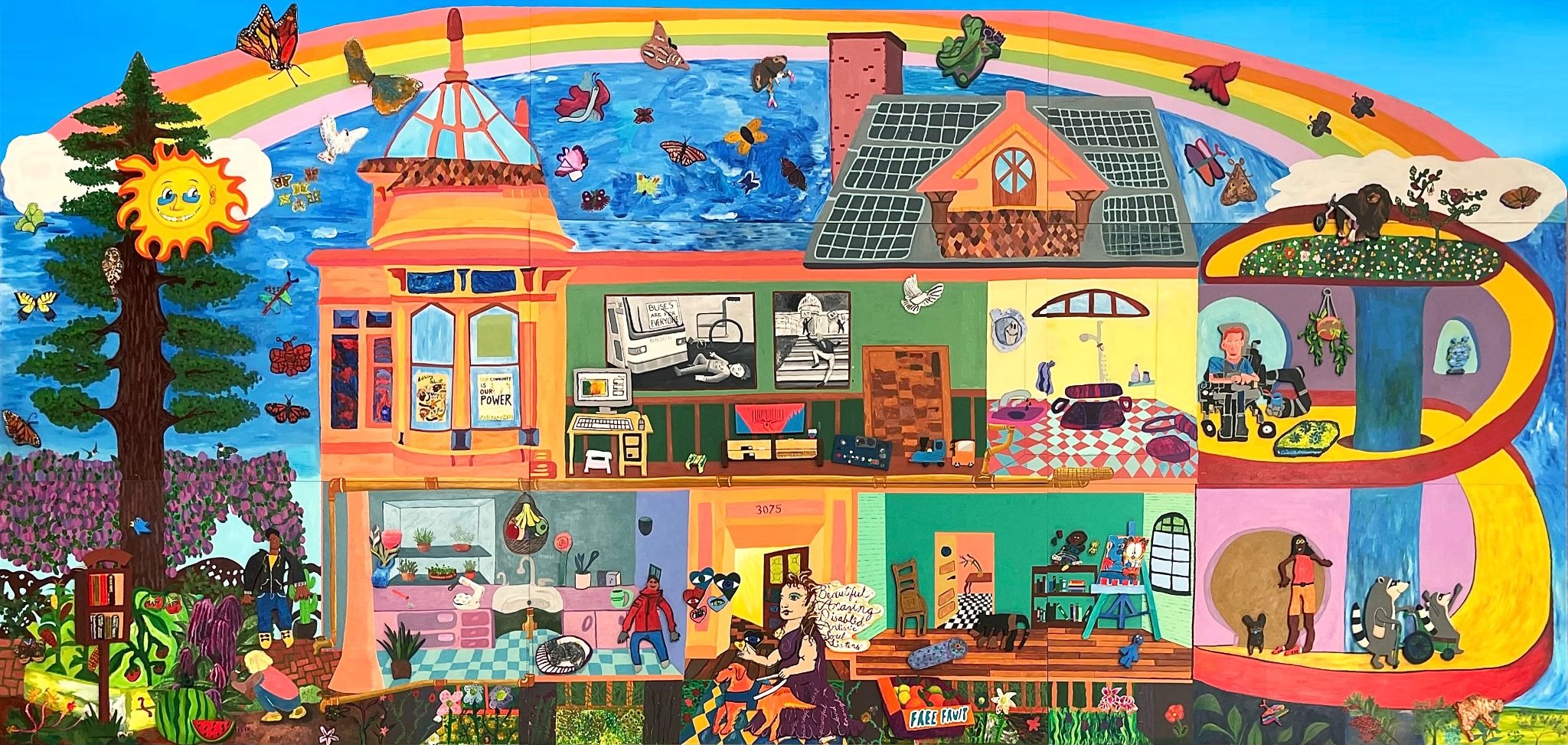
A Home For All
A public community arts mural, “A Home For All,” was inaugurated at the Ed Roberts Campus on May 27, 2026. Projecting the inner workings of our building into the public’s eye, it represents what our consortium manifests—a vision of mutual flourishing. The process and design empowered the abundant belonging that participants experience in programming offered by Ala Costa Centers alongside the greater ERC Community of advocacy and direct services organizations.
The primary facilitators, Carmelo Castro Netsky and Julian Mithra, set the intention to honor Berkeley’s legacy in disability justice while engaging with a new generation’s clarion call for joy and rest. In winter and spring of 2025, we convened a series of open meetings with a core cohort of Ala Costa participants and a showing of employees, artivists, organizers, and neighbors to explore how a site-specific art piece could serve our building and community. How do we design an image of justice and accessibility for all?
Over six months of gentle conversations, we allowed accessibility and function to inform our production process and form. Intergenerational “disability in action” arose as a theme centering adults with IDD. After exploring the theme through play and discussion, we co-envisioned a Victorian house cutaway to reveal the intimate and vulnerable spaces that support a life of rest, artistic expression, activism, care, connection, beauty, and environmental sustainability. Sensitive to access needs for people with physical and mobility disabilities as well as neurodivergence and invisible disabilities, the house was nurtured into being.
Rather than simply depicting a representation of wide accessibility in a domestic setting, we opened our entire process to Ala Costa participants and the wider community. Our model of slow and risky collaboration developed from a commitment to finding ways that anyone could participate. Whether that was designing a poster to get the word out about a meeting or asking a store for donations or sawing a piece of plywood, community members powered each stage of production.
Murals do not solely beautify a neighborhood, however, but create openings for individuals to forge a sense of community through discourse and engagement. The City of Berkeley acknowledges the potential of public art to effect positive change beyond aesthetics. They believe that such connecting projects “bolster community, enhance the built environment, and reflect the unique character of our city.” Furthermore, honoring Berkeley’s unique legacy in the national disability rights movement ensures that such histories remain relevant in this moment of reactionary politics.
Transcript from Audio
Lush textures and jewel tones welcome you to step into the mural. First, pause and smell the hot tomato leaves. At your feet, damp in their raised beds, grows two stalks of corn, so ripe their crimson and deep orange kernels are bursting from their cobs. A cascade of amaranth glows magenta next to the tomato. Three raggedly dandelions sneak through a gap in the herringbone brick pathway. A fuzzy honeybee clings to a dandelion. A smiling worm crawls up the side of the impressionistic garden box. A gardener dressed casually in blue jeans, bubblegum tank top, and banana yellow hightops crouches on the right side of the amaranth, facing away from you. Then you can browse books at a Little Library, specially curated to share books about disability justice. If you had a watering can, you could open the brass-handled faucet on the side of the house that connects, via copper pipes, to a greywater system. Behind the veggies, a bougainvillea vine grows in a canopy at the height of its blooming in magenta. Two hummingbirds hover above. Beneath the expanse of flowers, a rust-colored fence peeks through with an irregular top edge undulating with cut out faces and decorative holes. Finally, on the far right sits a potted San Pedro cactus in the iconic shape of two upturned arms beside a standing person wearing a red hoodie, blue jeans, with brown skin and red nail polish. Dominating the center of the garden is a symmetrical redwood tree, its crown above the roofline of the house. Its textured bark pulls you into sets of fuzzy, dappled clusters of needles. Near a lower branch, an incredibly detailed swallowtail butterfly hovers, with intricate white and yellow patterning and exquisite black and orange tails. On an upper branch perches a scruffy owl camouflaged for autumn. The owl is rendered with visible brushstrokes, giving a textured and ruffly effect.